
2026 Statistics PhD Survey
A summary of results from our 2026 Statistics PhD Survey
By Stats Life
In 2026, we conducted an opt-in survey of 66 people who have pursued a Statistics PhD. The majority of survey respondents have already graduated, but there are a few current students. The goal was to understand sentiment and opinions on topics like PhD satisfaction, the impact of AI, job titles, and career paths.
We acknowledge that there are issues with this type of survey: it's an opt-in, non-random sample of 66 respondents, drawn mostly from one department.1 Still, the trends are interesting, and the picture will sharpen over time as we run the survey annually with better coverage.
This post summarizes the primary findings of the survey. If you'd like to explore more, you can view an interactive visualization of the results at this link. With that, let's get into the results.
Most people are satisfied with the PhD, would do it again, and would recommend it to others
Most survey respondents were satisfied with the PhD. Specifically, ~90% said they were either 'Satisfied' or 'Extremely satisfied':
| Count | Percentage (%) | |
|---|---|---|
| 5 - Extremely satisfied | 33 | 50.0% |
| 4 - Satisfied | 26 | 39.4% |
| 3 - Neutral | 5 | 7.6% |
| 2 - Slightly dissatisfied | 2 | 3.0% |
| 1 - Not satisfied | 0 | 0.0% |
We unfortunately do not have a good benchmark to compare the 90% number against. For example, it would be interesting to see how this compares with Math or Physics PhDs.
Another data point related to satisfaction is that ~80% of respondents said that they would do their PhD again:
| Would you do the PhD again? | Count | Percentage (%) |
|---|---|---|
| Yes | 36 | 80.0% |
| Not sure | 6 | 13.3% |
| No | 3 | 6.7% |
Note
And ~77% said that they would recommend a PhD to others:
| Would recommend a PhD? | Count | Percentage (%) |
|---|---|---|
| Yes | 51 | 77.3% |
| No | 15 | 22.7% |
Many survey respondents highlighted that their recommendation was nuanced. This is well encapsulated in the following response:
It depends on what their goals are. If their goal is career advancement in non-academic roles --- which the vast majority of people will end up in --- then my perception is that hands-on experience in industry leads to faster career growth than doing a PhD. But, if their goal is to satisfy their curiosity about a topic they're passionate about, or to have a shot at an academic career, a PhD is one of the few ways to fulfill these goals.
— Data scientist in tech
Satisfaction varies by graduation year, university, and employment sector
There is considerable variation in satisfaction within different groups of survey respondents. Most notably, satisfaction declines by graduation year:
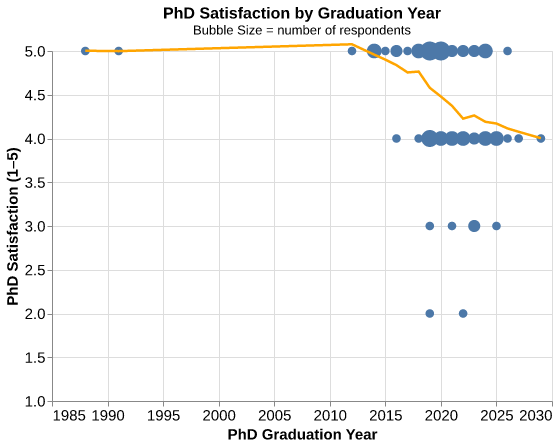
There are three hypotheses for why this is the case. The first is recency: people who just graduated may be more negative about their experience than those who have had more time to reflect. The second is that the decline is real. The third is that satisfaction dipped during COVID. We unfortunately can't distinguish between these, because we do not have multiple responses from the same person over time. We will get more insight into this next year, when we ask the same question to respondents one year later.
Satisfaction also varies by university. About 70% of survey respondents went to CMU, and satisfaction from CMU tended to be higher:
| CMU | Other | |
|---|---|---|
| Satisfaction (% rated 4-5) | 95.6% (43/45) | 76.2% (16/21) |
| Would recommend | 77.8% (35/45) | 76.2% (16/21) |
| Would do it again | 84.0% (21/25) | 75.0% (15/20) |
The final major variation in satisfaction is post-PhD employment sector. Respondents who stay in academia have higher satisfaction, compared with those who land in other sectors, and in particular the tech industry:
| Academia | Tech | Other | |
|---|---|---|---|
| Satisfaction (% rated 4-5) | 95.8% (23/24) | 86.4% (19/22) | 85.0% (17/20) |
| Would recommend | 87.5% (21/24) | 59.1% (13/22) | 85.0% (17/20) |
| Would do it again | 86.7% (13/15) | 64.3% (9/14) | 87.5% (14/16) |
One potential explanation for this is that, for professors, a PhD is directly linked to their current job:
You need to survive and thrive in the PhD environment to even have a chance to be a faculty running your own lab.
— Current biostatistics professor
This contrasts with industry respondents, where a PhD is not really necessary once you get a foot in the door:
Unlikely to help much for industry positions; the only people who should do a PhD are the people who will ignore all advice to not do one.
— Machine learning engineer in tech
Note
There are major differences by post-PhD employment sector
The difference in responses based on post-PhD employment sector are perhaps the most interesting. For example, the following chart identifies the most useful aspects of the PhD, split by post-PhD sector:
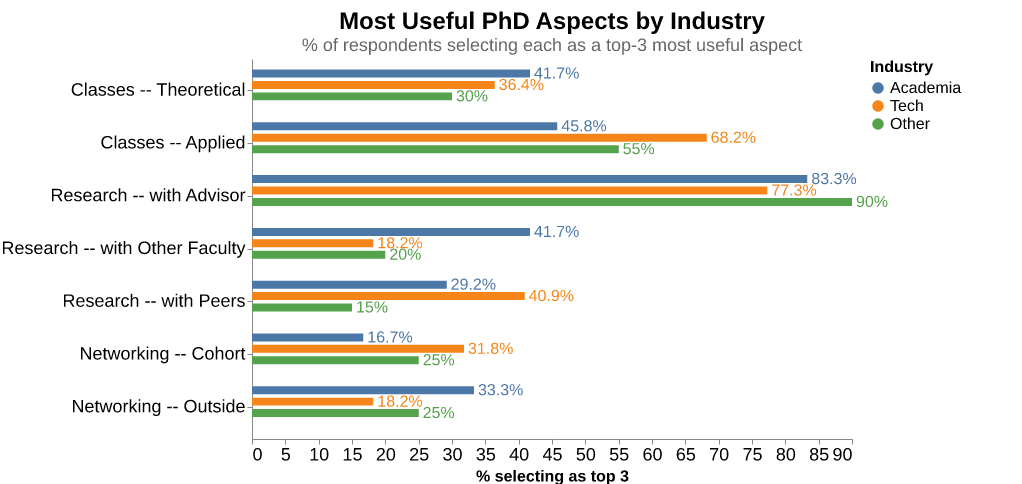
Respondents who work in tech were much more likely to find networking with peers, research with peers, and applied courses useful. In contrast, academics valued networking outside their cohort, doing research with other faculty, and valued theoretical courses more than tech respondents did. Notably, applied courses were deemed more useful than theoretical courses for both academia and industry. Each group agreed that research with their advisor was the most useful part of the PhD.
There is advice here for current/future PhD students. If you plan to go to industry, then your peers are the most important people to get to know. In academia, it is more important to mingle outside your cohort, either by doing research with other professors, or simply making connections for a future job search.
AI has the most impact in tech, and academics are the most concerned
~70% of tech sector respondents see AI having a major impact on their day-to-day job, which is the highest. Academia is most likely to forecast a major impact on the labor market, with 71% of respondents saying it will have a major impact:
| Question | Tech (N=22) | Academia (N=24) | Other (N=20) |
|---|---|---|---|
| AI impact: Day-to-day (% Major) | 68% | 46% | 55% |
| AI impact: Labor market (% Major) | 68% | 71% | 40% |
Academia's view on AI and the labor market is related to their forecast of a slowdown in hiring of statistics PhDs2:
| Demand Outlook | Tech (N=22) | Academia (N=24) | Other (N=20) |
|---|---|---|---|
| Increase | 23% | 21% | 30% |
| Stay the same | 59% | 42% | 35% |
| Decrease | 18% | 38% | 35% |
Part of this angst is well encapsulated in the following quotes, which emphasize that academia is focused on hiring people versed in AI:
Academia appears to be recruiting individuals who specialize in "AI". This means that computer scientists are pouring into the field. Right now, statisticians have to label themselves as "AI people".
— Recently on the academic job market
Everyone will want to hire people with "AI" PhDs instead, even if "AI" actually means things that statistics PhDs are good at.
— Current statistics professor
Industry folks are more open to switching jobs
Another major difference between industry and academia is their approach to the job search. The following table breaks down the job status of survey respondents:
| Employment Status | Tech (N=22) | Academia (N=24) | Other (N=20) |
|---|---|---|---|
| Not looking | 41% | 75% | 50% |
| Passively open | 55% | 8% | 30% |
| Actively looking | 5% | 17% | 20% |
The tech folks are most open to switching jobs: 55% are passively open to offers (though very few are actively looking). Some of this may be tied to location, as industry concentrates in big cities. It may also be the nature of the tech industry. This Stack Overflow survey shows similar figures.
There is another bit of useful advice here. If you enter academia, you will probably be either locked in on your current job, or actively seeking new jobs. If you enter industry, especially tech, you will be more attuned to the market, and switching jobs will be more frequent/fluid.
People like the sector they chose
When you look at the sectors respondents find appealing, it is not at all surprising that people are attracted to the sector they are in:
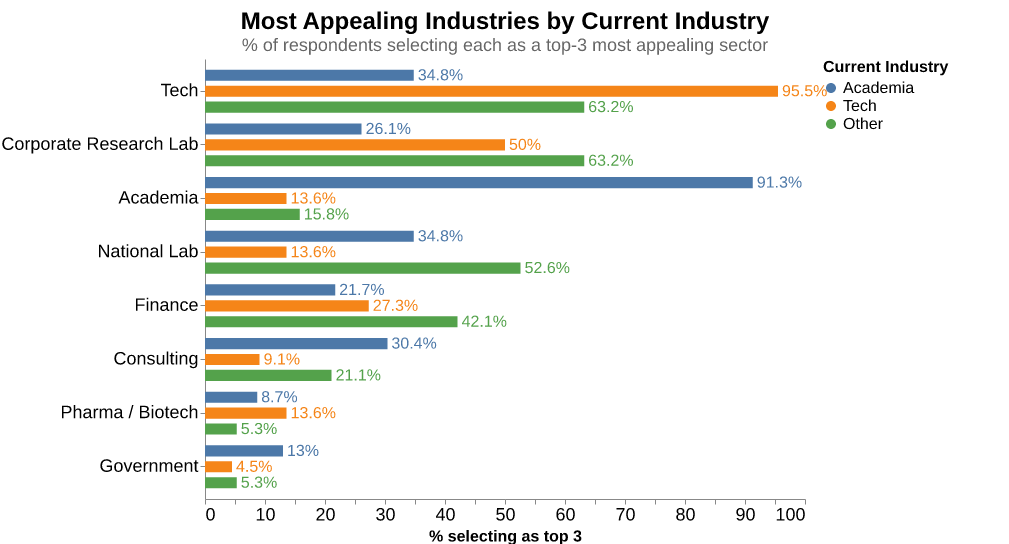
95% of tech people find the tech sector appealing. Their second and third choices are corporate research lab (e.g. DeepMind), and finance. All of these are fairly close to their current industry. The high appeal of finance and national labs within the 'Other' category happens because many respondents in that category work in finance, or a national lab.
In contrast, 91% of academics find academia appealing, followed by tech, national labs, and corporate labs. This also makes sense: corporate and national labs allow academics to keep publishing. And tech is clearly the most appealing non-academic sector.
Professor is the most prestigious job, Research Scientist tops non-academic roles
Job Title is always a hot button issue. We asked survey respondents how they viewed the prestige of various job titles:
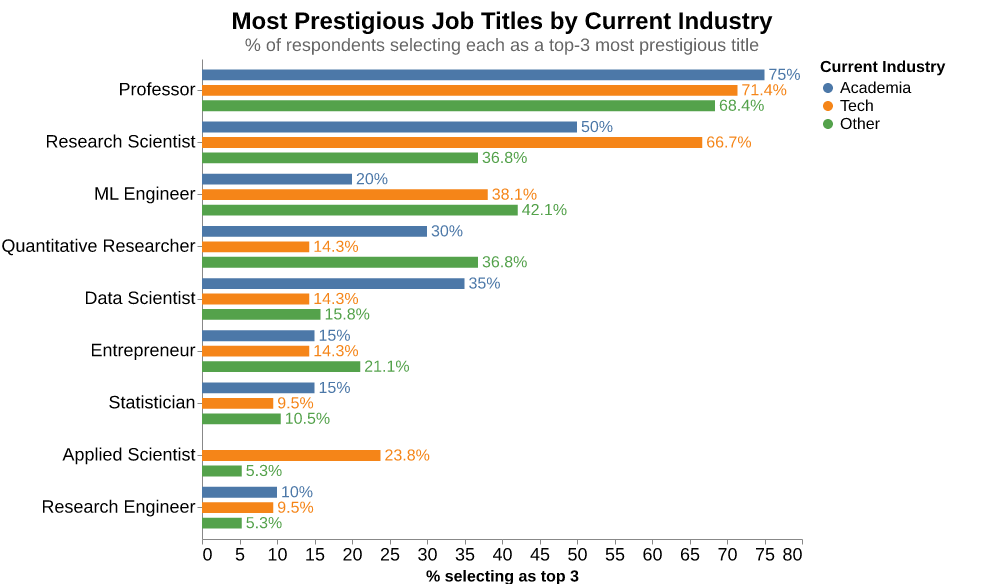
Across all groups, Professor rated as the most prestigious title. One hypothesis for this result is that all the survey respondents went through a PhD, which means they are more familiar with the effort involved to succeed in that path.
In tech, a close second was Research Scientist; 66% of respondents had it in their top three. Research Scientist is also #2 for academia, although across other sectors it ranks lower than Machine Learning Engineer and Quantitative Researcher. Entrepreneurs have a consistent, stable level of support across all sectors. One other surprise finding is that 'Data Scientist' is most prestigious in academia.
Tech sector job titles are idiosyncratic and constantly shifting
The tech sector, likely due to its newness and chutzpah, has a very distinct taste in job titles. For example, the Applied Scientist role is rising in prestige, beating out Data Scientist. The tech sector also places a higher value on the Machine Learning Engineer.
The perception of minor differences in job title within tech may be due to the fact that they perceive job title to be more important:
| Job Title is Important | Tech (N=22) | Academia (N=24) | Other (N=20) |
|---|---|---|---|
| Yes | 77% | 46% | 45% |
What explains this? Coupled with the higher likelihood of a job switch, tech respondents seem to believe that the job title is functionally useful, for instance in finding a new job:
Prestige points seem to count, at least for getting your foot in the door.
— Research scientist in tech
While industry respondents note the utility of the title, they also indicate that they 'wish it didn't matter':
Resume first impressions matter a lot when trying to stand out among thousands of applicants. I do think that the work content is the most important, but title unfortunately matters.
— Research scientist in finance
Others highlighted that having a specific job title is important when pivoting roles:
Extremely important especially when pivoting; it's hard to transition roles.
— Machine learning engineer in tech
Finally, respondents clearly distinguished the most prestigious job titles from those most helpful for career advancement:
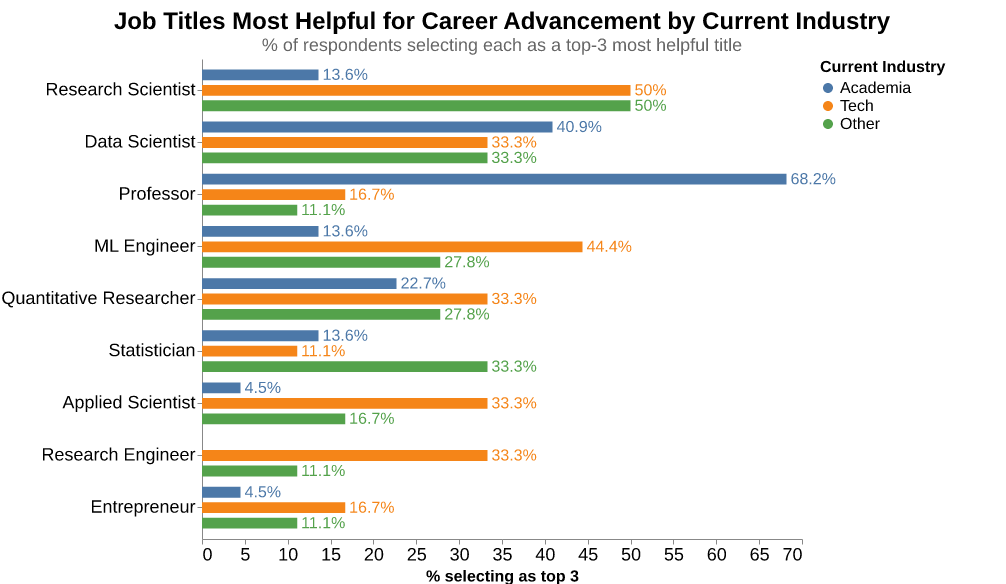
This is where Data Scientist, an established job ladder in most sectors at this point, is most valued. But if you drill down into the tech industry, you can see that Data Scientist is not more helpful than some of the newly established titles, such as Applied Scientist, or Research Engineer. This could be a sign of either a shift, or a sense that these roles are fairly interchangeable:
Job titles have sort of coalesced around data scientist, quantitative researcher, applied scientist, and machine learning engineer. I think people have become aware of how interchangeable these titles can be.
— Data scientist in finance
Finally, it is important to note that job title prestige depends to a large extent on the specific institution:
Yes, but only if tied to the affiliation. Being a professor at University X is different than University Y, and same for a Data Science Job.
— Data scientist in tech
Data Science prestige still exists, but it is waning
It was just 2012 when Data Scientist was deemed the sexiest job of the 21st century. But a major trend identified in this survey is that, at least for Statistics PhDs, it is no longer the highest prestige post-PhD job. This trend feels particularly important for the Statistics discipline, which had a major hand in the rise of data science, albeit somewhat under duress from external pressure.
One way to visualize this trend is by plotting a moving average of the proportion of respondents who rank Data Scientist one of the top three prestigious jobs, by graduation year:
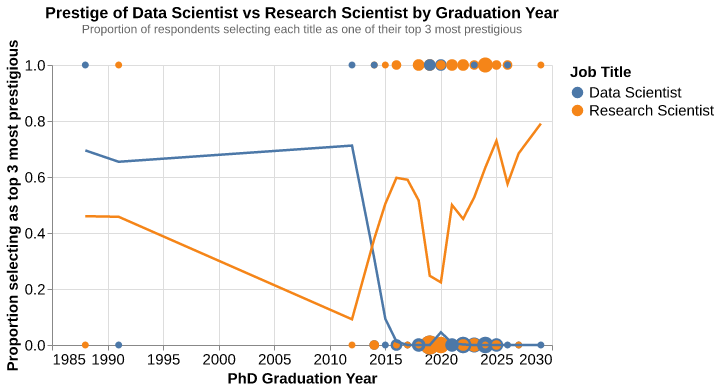
Recent graduates, who are most attuned to the job market, are even less likely to see Data Scientist as a prestigious job.
The shift from Data Scientist to Research Scientist may partly be explained by the AI wave, which has even more bravado than Big Data. At AI companies, Research Scientist is the job title of folks working at the frontier of LLMs.
The other explanation highlighted by multiple respondents is that the Data Scientist job has many new entrants, with very little barrier to entry:
The "sexiness" of a job title has always been extremely important (overly so) for one's future career moves. "Data Scientist" was once that sexy job title — infamously treading all over "Statistician". And now "data scientists" are a dime a dozen, as everyone and their mother have played with some spreadsheets, taken a Codecademy course, etc. and market themselves to the world as a "data scientist".
— Independent consultant
This is related to trends in title inflation, as job ladders within organizations re-brand themselves as Data Scientists:
It does seem like there is an implicit (all but explicit) pecking order, such that you might get taken more seriously applying to a next job if you're a Research Scientist (which is the future!) than if you're a Data Scientist (which thanks to title inflation is a title that many Analysts have).
— Data scientist in tech
Conclusion
This pilot study has been a fascinating window into the sentiment and opinions of Statistics PhDs. We summarized key takeaways in this blog post, but you can also view the results in an interactive app at the following link: 2026 Statistics PhD Survey.
If you have any questions or suggestions, please reach out!